1 Hadron physics
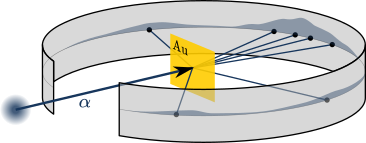
The origins of hadron physics lie in the same early 20th-century efforts that shaped nuclear and high-energy physics. Following the discovery of the electron in 1897, Rutherford’s scattering experiments between 1906 and 1913 revealed a dense atomic nucleus by scattering helium nuclei (\(\alpha\) particles) on a metal foil [1], which he later showed in 1919 as containing protons [2]. The experiments mark the beginning of particle scattering, where distributions are used as a quantitative measure to extract information about the microscopic scale (Figure 1.1), and opened the door to formulating the problem in terms of probabilities rather than classical trajectories (Chapter 2).
By itself, however, the proton could not account for the differing masses of isotopes, which called for a neutral counterpart to the proton [3]. The puzzle was resolved in 1932, when James Chadwick proved the existence of a neutron [4], a particle with similar properties to that of the protons, but without charge and with a slightly larger mass. The nature of the force responsible for holding protons and neutrons – collectively known as nucleons – together within the atomic nucleus remained unresolved. This nuclear force had to be strong enough to overcome the electrostatic repulsion between positively charged protons, yet short-ranged enough to prevent nuclei from growing indefinitely large.
1.1 Symmetries and quantum numbers
At the same time, quantum theory had revealed that particles such as the proton, neutron, and electron possess an intrinsic form of angular momentum known as spin. The idea was introduced to explain a puzzling feature in atomic spectra: certain spectral lines appeared to be subtly split. In 1925, Uhlenbeck and Goudsmit proposed that electrons carry an internal twist or spin (“Eigenrotation”) that interacts with the magnetic field generated by their motion around the nucleus, producing this fine-structure splitting [5]. This new degree of freedom was later formalised within quantum mechanics as an intrinsic angular momentum, the operator of which is denoted by \(\mathbf{S}\), which couples to the orbital angular momentum \(\mathbf{L}\) of the particle’s motion to form the total angular momentum \(\mathbf{J} = \mathbf{L} + \mathbf{S}\) (see Section 3.2.2). This relation is known as angular-momentum addition, and it reflects the underlying symmetry group \(\mathrm{SU}(2)\), the special unitary group of \(2\times 2\) matrices,
\[ \mathrm{SU}(2) = \left\{\,\mathbfit{U} \in \operatorname{Mat}_{2\times 2}(\mathbb{C}) \;\middle|\; \mathbfit{U}^\dagger \mathbfit{U} = \mathbf{1},\; \det \mathbfit{U} = 1 \,\right\} \,, \tag{1.1}\]
whose algebra enforces that angular momenta can take only discrete total values \(s=0,\tfrac{1}{2},1,\dots\) and discrete projections \(-s,-s+1,\dots,+s\) along a chosen quantisation axis. For a spin‑\(\tfrac{1}{2}\) particle such as the electron, this means only two possible outcomes, conventionally called “up” and “down”.
The quantisation of spin not only fixes the projections of individual particles, but also dictates how systems of identical particles behave collectively. Particles with half-integer spin, such as electrons and nucleons, obey the Pauli exclusion principle [6], which forbids two identical particles from occupying the same quantum state. These particles are known as fermions, since their wave functions are antisymmetric (“flip sign”) under exchange and follow Fermi–Dirac statistics [7; 8]. In contrast, particles with integer spin are called bosons and follow Bose–Einstein statistics [9], which allow any number of identical particles to share the same state. This distinction also determines which types of particles can mediate forces: bosons can be exchanged between fermions, as they are unrestricted by exclusion.
Since the photon that mediates the electromagnetic force was already known to obey Bose–Einstein statistics, it was natural to expect that the nuclear force would be carried by a boson as well. In 1935, Yukawa proposed a new particle – the meson – to transmit the interaction between nucleons, “just as the electromagnetic field is accompanied by the photon” [10]. To account for the short range of the nuclear force, he argued that the mediator must be far heavier than the electron, since light particles give rise to long-range forces, but lighter than the proton so that it could still be produced in nuclear processes. He therefore predicted a mass between that of the electron and proton – hence, “meson” – which would yield a range comparable to the size of the nucleus.
As Yukawa anticipated, cosmic rays soon offered a glimpse of this new particle. In 1937, Anderson and Neddermeyer observed a charged particle that behaved like a heavy electron [11; 12] (“mesotron” [13]). It was mistaken for Yukawa’s meson, as it lay in the predicted mass range, and it took another ten years before it was shown that this mesotron did not interact strongly with the nucleus [14]. Rather, the mesotron was a secondary decay product [15] – a “\(\mu\)‑meson” [16], or muon – of a primary particle – a “\(\pi\)”‑meson, or pion – which did interact through nuclear scattering and absorption. Like the electron, the muon followed Fermi–Dirac statistics and interacted electromagnetically, and was therefore put under a new category of leptons [17, p. VIII].
What made these pions interact with nucleons? Already in 1932 [18], Heisenberg had introduced the idea of a new spin-like quantum number \(\rho\) – later dubbed isotopic spin, or isospin [19] – to explain why protons and neutrons interacted so similarly via the strong force [20]. The two were seen as a “doublet” representation of a single nucleon state that are distinguished by a degree of freedom (isospin), much like up and down spin states of the electron. Yukawa’s meson field naturally fit into this symmetry scheme as a force mediator with integral isospin, so that a nucleon flips its isospin by emitting a pion [21]. Extending the concept of isospin to force mediators even led to the prediction of a neutral pion state to complete the “triplet” of integral isospin states [22], which was discovered soon after the charged pions [23].
At this stage, symmetry principles and quantum numbers had become an important tool for classifying the proliferating array of new particles. As detection methods improved, especially with accelerators in the 1950s, a growing number of short-lived particles were discovered (see Table 1.1). To bring order to this chaos, physicists grouped the heavier, strongly interacting particles – including the proton and neutron – under the common label baryons [24], distinguishing them from the lighter mesons. Some, however, like “\(K\) mesons” (kaons) and “\(V\) particles” (hyperons [25]), displayed unexpectedly long lifetimes or unusual decay patterns. These new states didn’t fit into existing categories and formed a bewildering “particle zoo”.
| Particle | Discovered | Predicted | |
|---|---|---|---|
| \(e^-\) | electron | 1897 [26] | |
| \(p\) | proton | 1919 [2] | |
| \(n\) | neutron | 1932 [4] | 1920 [3] |
| \(e^+\) | positron | 1932 [27] | 1931 [28] |
| \(\mu^-\) | muon | 1936–1937 [29; 12] | |
| \(\pi^\pm\) | charged pion | 1947 [15] | 1935 [10] |
| \(\pi^0\) | neutral pion | 1950 [23] | 1938 [22] |
| \(K^\pm\) | charged kaon | 1947 [30] | |
| \(K^0\) | neutral kaon | 1949 [31] | |
| \(\varLambda\) | Lambda | 1950 [32] | |
| \(\varXi\) | Xi or “cascade” | 1952 [33; 34] | |
| \(\varSigma^\pm\) | Sigma | 1953 [35] | |
| \(\eta\) | eta | 1961 [36] | 1959 [37] |
| \(\varOmega\) | Omega | 1964 [38] | 1961 [39] |
The proliferation of strongly interacting particles made it clear that existing categories were no longer sufficient. Rather than postulate entirely new constituents, physicists sought regularities in how these particles could be grouped and compared [41]. Quantum numbers – discrete labels associated with conserved quantities – emerged as the guiding principle for this approach. The earlier concept of isospin, which had already unified protons, neutrons, and pions into symmetrical multiplets under an \(\mathrm{SU}(2)\) structure, provided a blueprint: perhaps other groupings could be understood in the same way.
Yet some of the newly discovered states, such as kaons and hyperons, exhibited unusual behaviour. For example, while the \(\varLambda\) hyperon was produced abundantly in cosmic rays and collisions, its dominant decay \(\varLambda \;\to\; p\,\pi^-\) would violate isospin conservation if it proceeded through the strong force. Instead, the decay occurred only via the weak interaction, giving the \(\varLambda\) hyperon its unusually long lifetime for a hadron. To account for such anomalies, a new additive quantum number – strangeness – was proposed [42]. Conserved in strong interactions but violated in weak decays, it explained why these particles were readily produced but decayed slowly, and allowed them to be systematically included in extended symmetry schemes [43; 44].
As the study of neutral mesons and vector mesons advanced in the 1950s, physicists realised that the concept of charge conjugation – exchanging particles with their antiparticles – could be used to classify states that are their own antiparticles (self-conjugate). This led to the definition of \(C\)‑parity [45], a quantum number that tells whether the wave function of a self-conjugate particle changes sign under this operation. Alongside charge conjugation, parity (\(P\)) described how a particle’s wave function transforms under spatial inversion \(\vec{x} \to -\vec{x}\). To extend similar symmetry constraints to charged members of isospin multiplets, for which \(C\)‑parity cannot be defined, physicists introduced \(G\)‑parity [46], defined as \(G=Ce^{i\pi I_2}\). The prediction and discovery of the \(\eta\) meson in 1961 [39; 36] provided another example of a neutral meson whose decays could be constrained by these discrete symmetries. Together with total spin \(J\), isospin \(I\), and strangeness, these quantum numbers formed a powerful labelling scheme. It was in this context that the collective term hadron was coined [47], denoting all particles that participate in strong interactions, in contrast to leptons and gauge bosons.
Although originally introduced case by case to solve specific experimental puzzles, we today understand these quantum numbers as manifestations of underlying symmetry principles, with conservation laws arising from those symmetries. Some, like electric charge or baryon number, are additive because they derive from continuous internal symmetries (such as a phase rotation, forming the group \(\mathrm{U}(1)=\left\{e^{i\phi}\mid\phi\in\mathbb{R}\right\}\)), so the total value is obtained by simple summation over constituents. Additive quantum numbers also include strangeness and the separate lepton numbers that apply to each lepton type (\(e,\mu,\tau\)). Others, like the parity operations, are multiplicative, because they reflect discrete symmetries such as spatial inversion or particle–antiparticle exchange; in these cases the wave function is either preserved (\(+1\)) or changes sign (\(-1\)). For orbital motion, parity includes an additional factor \(\times(-1)^L\) with orbital angular momentum \(L\). Finally, spin and isospin follow the rules of \(\mathrm{SU}(2)\) addition, reflecting the non-Abelian continuous algebra of rotations, where their conservation takes the form of angular-momentum coupling. Hadrons are not labelled by the intrinsic spin \(s\) of their constituents, but by the total angular momentum \(J\), obtained through angular-momentum addition. Together, the labels \(J\) for total angular momentum and \(I, I_3\) for isospin and its projection form the basis of the hadron classification scheme, where states are organised by combinations such as \(J^{PC}(I^G)\). These categories are summarised in Table 1.2.
| Quantum number | Symbol | Strong | EM | Weak | Conservation rule |
|---|---|---|---|---|---|
| Electric charge | \(Q\) | ✅ | ✅ | ✅ | Additive |
| Spin | \(J\) | ✅ | ✅ | ✅ | \(\mathrm{SU}(2)\) addition |
| Baryon number | ✅ | ✅ | ✅ | Additive [48] | |
| Lepton number | ✅ | ✅ | ✅ | Additive | |
| Strangeness | ✅ | ✅ | ❌ | Additive | |
| Parity | \(P\) | ✅ | ✅ | ❌ | Multiplicative \(\times(-1)^L\) |
| \(C\)‑parity | \(C\) | ✅ | ✅ | ❌ | Multiplicative |
| \(G\)‑parity | \(G\) | ✅ | ❌ | ❌ | Multiplicative |
| Isospin | \((I, I_3)\) | ✅ | ❌ | ❌ | \(\mathrm{SU}(2)\) addition |
1.2 The Eightfold Way and the quark model
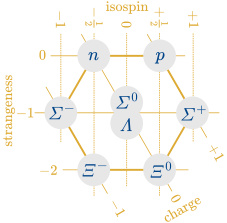
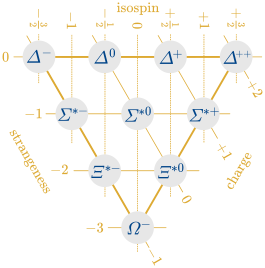
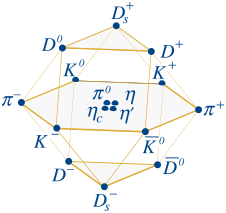
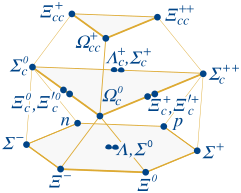
As more hadrons were discovered, their regularities pointed toward an even deeper symmetry, what we now call flavour symmetry. In the early 1960s, Gell-Mann and Ne’eman independently proposed the Eightfold Way [39; 49; 50], a classification scheme based on \(\mathrm{SU}(3)\) group symmetry. Isospin formed an \(\mathrm{SU}(2)\) subgroup, as expressed in Equation (1.1), and the inclusion of strangeness called for an extension of that symmetry. Hadrons were organised into multiplets, sets of states related by the symmetry, much as angular-momentum coupling produces families of states in atomic physics. The structure of these multiplets is conveniently displayed in weight diagrams that plot the states according to their strangeness \(S\) and isospin projection \(I_3\) (Figure 1.2 for mesons and Figure 1.3 for baryons). When \(S\) and \(I_3\) are on the vertical and horizontal axes, the electric charge \(Q\) runs diagonally across the diagram, as it is related to \(S\), \(I_3\), and baryon number \(B\) via the Gell-Mann–Nishijima relation,
\[Q = I_3 + \tfrac{1}{2}(B+S) \,. \]
Within each multiplet, states are distinguished by their total spin and parity, which result from coupling intrinsic spin to orbital angular momentum \(L\). The clearest patterns arise for the ground states with \(L=0\). These give the \(J^P=0^-\) pseudoscalar mesons (e.g. pions and kaons) and the \(J^P=1^-\) vector mesons (e.g. \(\rho\) and \(K^*\)). Higher orbital excitations generate further families such as the scalar (\(0^+\)), axial-vector (\(1^+\)), and tensor (\(2^+\)) mesons, but these have larger masses and tend to mix more strongly.
For mesons, the most characteristic pattern is the octet: eight states arranged in a hexagonal weight diagram with neutral members in the centre. An additional singlet accompanies the octet, so the observed spectrum forms a nonet of nine states. This is why the diagrams in Figure 1.2 show three neutral entries in the centre: one belongs to the octet, the other to the singlet, and together they mix to form the observed \(\eta\)–\(\eta'\) and \(\omega\)–\(\phi\) pairs. In the pseudoscalar case, the \(\eta'\) meson is sometimes omitted from the nonet diagram, since it is predominantly a singlet state and its mass lies far above that of its octet companions. For vector mesons, the octet and singlet mix better, producing the physical \(\omega\) and \(\phi\) alongside the \(\rho\) and \(K^*\).
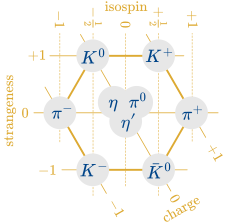
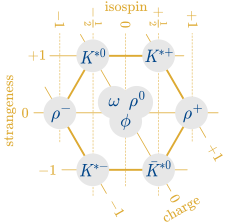
In the baryon sector, shown in Figure 1.3, the pattern differs. The spin‑\(\tfrac{1}{2}\) baryons (nucleon, \(\varLambda\), \(\varSigma\), and \(\varXi\)) form an octet, while the spin‑\(\tfrac{3}{2}\) states (\(\varDelta\), \(\varSigma^*\), \(\varXi^*\), and \(\varOmega^-\)) arrange into a decuplet. A spectacular confirmation of this scheme came in 1964 with the discovery of the \(\varOmega^-\) [38], the predicted missing member of the decuplet, whose mass and decay properties matched the expectations of the Eightfold Way with remarkable precision.
Out of this symmetry-based classification emerged a new idea: that hadrons were not fundamental, but composite particles made of simpler constituents. These hypothetical building blocks – eventually named quarks – were proposed independently by Gell-Mann [51] and Zweig [52] in the mid-1960s. The Eightfold Way’s multiplet structure hinted at an underlying triplet, leading to the postulation of three quark types (flavours): up, down, and strange. These carry fractional electric charges (\({+}\tfrac{2}{3}\) or \({-}\tfrac{1}{3}\) of the electron charge) and transform according to the fundamental representation of \(\mathrm{SU}(3)\). Because no free particles with such fractional charges were known, Gell-Mann described quarks as “mathematical” entities – permanently confined and not observable in isolation – whereas Zweig’s “aces” were presented more straightforwardly as physical constituents [53; 54]. The \(\mathrm{SU}(2)\) isospin subgroup now reflects the relative numbers of up and down quarks: its projection \(I_3\) equals half the difference between the number of up and down quarks, while the total isospin \(I\) determines the multiplet the hadron belongs to.
As experiments ran into other anomalies and puzzling behaviour of the weak interaction, theorists soon realised that a fourth quark, charm, was needed to complete the picture, extending the flavour symmetry to an approximate \(\mathrm{SU}(4)\) symmetry (see Figure 1.4) and explaining the absence of certain flavour-changing neutral currents [55; 56]. Initially conceived as a mathematical tool to encode symmetry patterns [57, p. 73], the quark model soon began to be taken more seriously as a physical picture of hadrons, especially after deep inelastic scattering experiments at SLAC revealed evidence of point-like constituents inside the proton [58; 59].
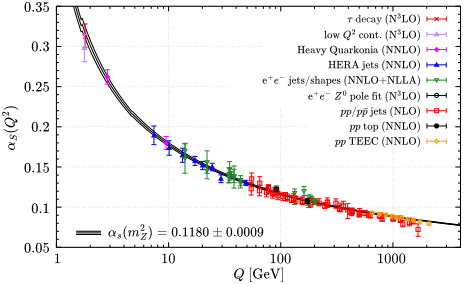
A theoretical foundation for the strong interaction arrived only later, with the development of Quantum Chromodynamics (QCD) in the early 1970s [61]. While the Eightfold Way was based on a global \(\mathrm{SU}(3)\) flavour symmetry, QCD introduced a fundamentally different structure: a local \(\mathrm{SU}(3)\) gauge symmetry. This symmetry, acting in an internal space later dubbed colour [62; 63], governs the interactions between quarks and massless vector bosons known as gluons [64]. Unlike flavour symmetry, which described patterns among hadrons, this local gauge symmetry dictated the dynamics of the strong force at a fundamental level. At the time, however, it was unclear whether such a theory could be consistent: local gauge theories were thought to become uncontrollably strong at high energies, making calculations divergent and predictions unreliable. A turning point came in 1973 with the discovery of asymptotic freedom by Gross, Wilczek, and Politzer [65; 66]. They realised that, in non-Abelian gauge theories like QCD, the coupling strength decreases at high energies, allowing for meaningful, perturbative calculations. This behaviour is illustrated in Figure 1.5, which shows experimental measurements of the coupling strength \(\alpha_s\) at different energy scales \(Q\). The measurements confirm the predictions of QCD: \(\alpha_s\) is large at low energies (large distances), but decreases asymptotically with increasing \(Q\) (smaller distances).
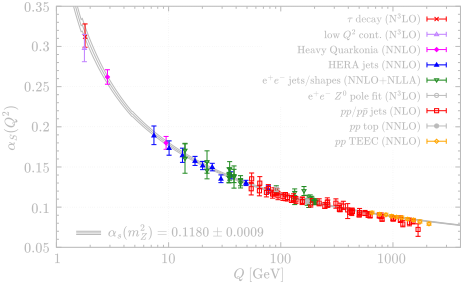
This breakthrough explained why quarks, though nearly free in high-energy collisions, can never be observed in isolation. Their new quantum number of colour charge – coming in three types (red, green, blue) and governed by a local \(\mathrm{SU}(3)\) symmetry – implies that only colourless combinations can exist as physical states. This resolves puzzles such as the spin‑\(\tfrac{3}{2}\) baryons like \(\varOmega^-=\ket{s\!\uparrow s\!\uparrow s\!\uparrow}\) and \(\varDelta^{++}=\ket{u\!\uparrow u\!\uparrow u\!\uparrow}\), which would violate the Pauli exclusion principle if quarks carried only flavour and spin. QCD thus predicts a dual behaviour: quarks interact almost as free particles at short distances (asymptotic freedom), but are inseparably bound at long distances, giving rise to confinement. The observable spectrum consists solely of colour-singlet states: three quarks of different colours form a baryon, while a quark–antiquark pair forms a meson (see Figure 1.6).
Once such colour-neutral combinations are admitted, the familiar multiplet structure of the Eightfold Way naturally emerges. Quarks transform in the fundamental representation of flavour \(\mathrm{SU}(3)\), denoted as a colour triplet \(\mathbf{3}\). Tensor products of these triplets decompose into irreducible multiplets, reproducing the observed hadron patterns. In particular, mesons arise from \(\mathbf{3}\otimes\overline{\mathbf{3}}=\mathbf{8}\oplus\mathbf{1}\) (Figure 1.2), while baryons follow from \(\mathbf{3}\otimes\mathbf{3}\otimes\mathbf{3}=\mathbf{10}\oplus\mathbf{8}\oplus\mathbf{8}\oplus\mathbf{1}\) (Figure 1.3).
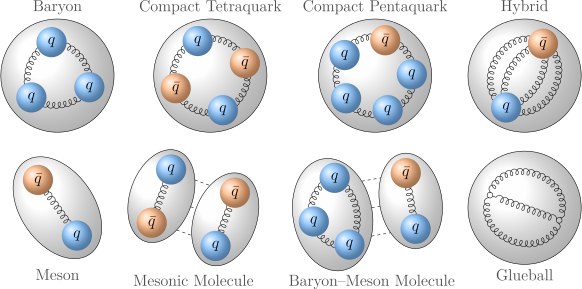
Gell-Mann also predicted other colourless combinations, such as tetraquarks (two quarks and two antiquarks) and pentaquarks (four quarks and one antiquark). In recent decades, other exotic configurations have been discussed, including glueballs (bound states consisting of gluons only), hybrids (quark–antiquark pairs with gluonic excitations), and hadronic molecules (loosely bound states of mesons and baryons). Unlike photons in QED, gluons themselves carry colour charge and can interact with each other, which causes the QCD coupling to grow stronger as the energy decreases. This strong coupling makes quarks and gluons inseparable, but marks the non-perturbative regime at low energies, where symmetry principles, phenomenology, and experiment are our only tools for mapping the rich spectrum of bound states emerging from QCD.
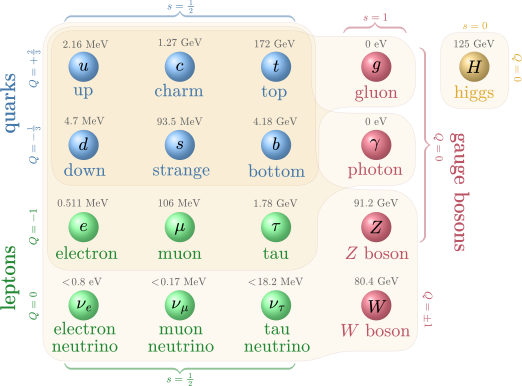
Today, we know there are six quark flavours within three generations of increasing masses: up and down, strange and charm, and bottom and top. The lightest pair build stable protons and neutrons, while strange, charm, and bottom quarks give rise to heavier, short-lived hadrons. By contrast, the top quark is so massive and short-lived that it decays before hadronising. Alongside three families of leptons (the electron, muon, tau, and their neutrinos), the force carriers (photon, gluons, \(W\) and \(Z\) bosons), and the Higgs boson, these quarks complete the Standard Model (Figure 1.7), our most fundamental description of nature’s building blocks. Yet in the strongly interacting regime, where quarks remain confined, hadron physics investigates the emergent spectrum of composite states, with the aim of understanding the non-perturbative dynamics of QCD and uncovering mechanisms beyond current models.
1.3 Nucleon excitations
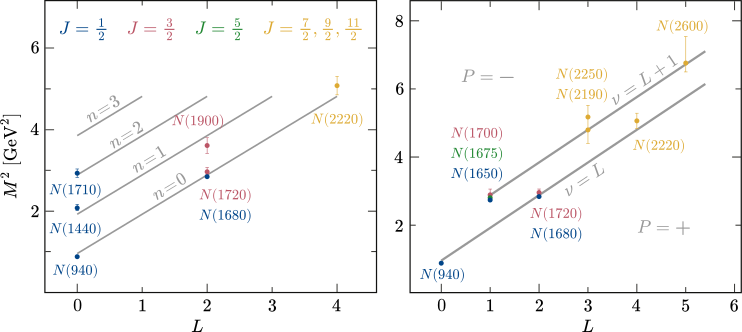
Having seen how quantum numbers and symmetries organise hadrons into meson and baryon multiplets, it is natural to ask how these patterns extend beyond the ground states. This question is particularly pressing for nucleons, because they, unlike strange or charmed baryons, are built solely from three light quarks of nearly equal mass. With no heavy constituent to dominate the dynamics, the complex interplay of all three quarks and of the gluons that bind them becomes fully exposed. Historically, scattering experiments revealed an increasing number of baryon resonances whose squared masses and spins follow an approximately linear relationship. These patterns became known as Regge trajectories [69]. This invited the question of how such excitations arise in the quark model. Just as atoms have discrete excited states when their electrons occupy higher orbitals, hadrons can exist in configurations where their constituent quarks rearrange their relative motion and spin alignments. These radial and orbital excitations manifest as heavier, unstable resonances that populate the observed Regge trajectories [70].
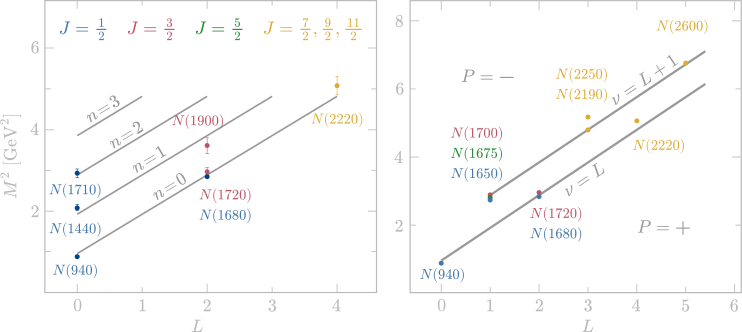
An example is shown in Figure 1.8, where excitations of the nucleon, also called \(N^*\) resonances, align along straight lines when plotted as their squared mass \(M^2\) versus orbital angular momentum \(L\). The left panel displays the radial excitation spectrum of positive-parity nucleons, where successive radial quantum numbers \(n\) generate parallel trajectories. The right panel uses a “light-front holographic classification” [71], where grouping excitations by parity results in two nearly parallel trajectories.
Non-relativistic quark model
To classify these possible states, the idea of \(\mathrm{SU}(3)\) flavour symmetry for light hadrons – which applies to hadrons composed of up, down, and strange quarks – can be extended by including the spin degrees of freedom, which are described by an \(\mathrm{SU}(2)\) symmetry. In the non-relativistic quark model [72], this leads to an approximate \(\mathrm{SU}(6)\) spin–flavour symmetry,
\[ \mathrm{SU}(6) \supset \mathrm{SU}(3)_\text{flavour} \times \mathrm{SU}(2)_\text{spin} \,, \tag{1.2}\]
where each quark transforms as a 6-dimensional spin–flavour multiplet. Light baryons are then described by the tensor product of three such quark states:
\[\mathbf{6}\otimes\mathbf{6}\otimes\mathbf{6} = \mathbf{56}_{\mathcal{S}} \oplus \mathbf{70}_{\mathcal{M}} \oplus \mathbf{70}_{\mathcal{M}} \oplus \mathbf{20}_{\mathcal{A}} \,. \]
The subscript of each multiplet indicates whether its spin–flavour wave function is symmetric (\(\mathcal{S}\)), antisymmetric (\(\mathcal{A}\)), or mixed-symmetric (\(\mathcal{M}\)) under exchange of any two quarks. Because quarks are fermions, the Pauli exclusion principle requires the total baryon wave function \(\Psi_\text{total}\) to be antisymmetric. In the non-relativistic quark model, this wave function factorises into three parts – colour, spin–flavour, and orbital (spatial):
\[ \Psi_\text{total}= \Psi_\text{colour} \times \Psi_\text{spin–flavour} \times \Psi_\text{space} \,. \]
The colour part of a baryon is always totally antisymmetric, because \(\Psi_\text{colour}=\epsilon_{abc}\,\ket{q_a q_b q_c}\), ensuring that the state is colourless. It follows that the product of the spin–flavour and space components must be symmetric. Hence, once the symmetry of the spin–flavour part is specified (as indicated by the subscripts), the orbital part is fixed to carry the complementary symmetry required to maintain an overall symmetric product.
In particular, the symmetric \(\mathbf{56}\)‑plet must combine with a symmetric orbital wave function, which means that all three quarks occupy the lowest S-wave orbital (no orbital angular momentum). Indeed, this \(\mathbf{56}\)‑plet contains the familiar ground-state baryons. These are the spin-1/2 octet and spin-3/2 decuplet shown in Figure 1.3 of the \(\mathrm{SU}(3)_\text{flavour} \times \mathrm{SU}(2)_\text{spin}\) subgroup of Equation (1.2). By contrast, the two \(\mathbf{70}_{\mathcal{M}}\) multiplets have spin–flavour wave functions that are mixed-symmetric under quark exchange. To maintain the required total antisymmetry, the orbital part must then also be mixed-symmetric, which naturally occurs when the three quarks are excited into states with non-zero orbital angular momentum. For example, a P-wave (\(L = 1\)) orbital configuration introduces mixed symmetry into the spatial part, allowing these \(\mathbf{70}_{\mathcal{M}}\) states to describe many of the excited baryons with negative parity for \(L = 1\). The \(\mathbf{20}_{\mathcal{A}}\) multiplet has a spin–flavour wave function that is fully antisymmetric, so its orbital part must be fully symmetric, like the \(\mathbf{56}\). However, because of its antisymmetric spin–flavour structure, it does not appear in the simplest non-relativistic quark model for ground-state baryons and is regarded mainly as a theoretical curiosity, since no clear experimental evidence exists for such states.
In addition to these orbital excitations, the quark model also predicts radial excitations, where the quarks remain in the same spin–flavour and orbital configuration, but their spatial wave function acquires additional nodes, much like atomic orbitals. The Roper resonance \(N(1440)\) is a classic example, which was traditionally interpreted as the first radial excitation of the nucleon within the \(\mathbf{56}_{\mathcal{S}}\) multiplet. Its structure, however, may be more intricate: strong coupling to meson–baryon channels suggests the presence of a surrounding meson cloud, which could also account for its unexpectedly low mass [73]. These radial excitations add even more predicted nucleon states to the spectrum, many of which have yet to be observed.
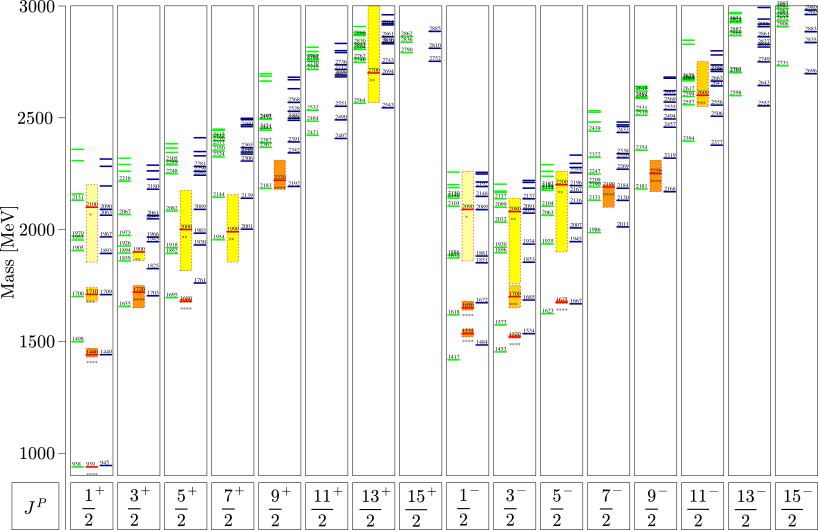
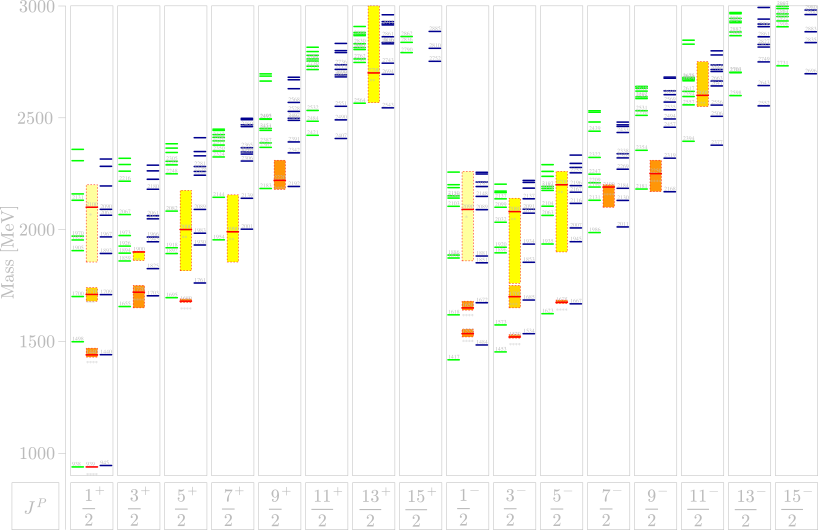
The non-relativistic quark model is just one of several frameworks used to describe the nucleon excitation spectrum. Other approaches include effective field theories, lattice QCD calculations, and light-front holography [74]. These frameworks aim to reproduce the masses of experimentally observed resonances, but typically predict many more states than have been confirmed. Figure 1.9 shows the measured \(N^*\) spectrum placed between two sets of predictions from theoretical models. While the overall structure is reproduced, clear mismatches remain. Some predicted states, such as the many excited states predicted in the \(\mathbf{70}_{\mathcal{M}}\) sector, have not been observed in experiment, while some observed states cannot easily explained by theory. This “missing resonance puzzle” underscores that the nucleon spectrum reflects dynamics beyond the simplest constituent-quark picture and provides a testing ground for non-perturbative QCD.
\(N^*\) resonances in scattering processes
Unlike strange or charmed baryons, where a heavier quark dominates the system and helps simplify the dynamics, the nucleon consists solely of up and down quarks with nearly identical masses (approximately \(2.2\text{ MeV}\) and \(4.7\text{ MeV}\), respectively). This absence of an internal mass hierarchy means that all three quarks must be treated on equal footing, making the nucleon an ideal system for testing how confinement and dynamical chiral symmetry breaking emerge from the underlying quark–gluon interactions [77]. As we saw in Figure 1.3, light baryons fall into spin‑\(\tfrac{1}{2}\) or spin‑\(\tfrac{3}{2}\) multiplets. Excitations of the latter are the \(\varDelta\) resonances, while excitations of the former are the \(N\) resonances or \(N^*\)’s [60, §81], which are the focus of this study.
Most \(N^*\)’s are unstable and have to be produced and observed indirectly. Instead, they appear as intermediate states in reactions where an incoming probe excites a nucleon target (usually a proton). Historically, pion–nucleon scattering (\(\pi N\)) in fixed-target experiments provided the first systematic evidence for nucleon excitations, starting in 1957 [70]. Examples are experiments at the Los Alamos Meson Physics Facility (LAMPF), at Brookhaven National Laboratory (BNL) with the Crystal Ball detector, and at the Paul-Scherrer-Institute (PSI) in Switzerland. In these experiments, a pion beam excites the nucleon to a \(\varDelta^*\) or \(N^*\) state, which then decays into final states such as \(\pi N\), \(\pi\pi N\), or \(\eta N\). An advantage of pion–nucleon scattering is that the number of contributing partial waves (the different angular-momentum components in which the scattering process can be decomposed) remains relatively limited, which makes it easier to extract resonance properties, although this also restricts the range of excitations that are produced [70].
Photo- and electro-production experiments such as the Crystal Barrel detector at the CB‑ELSA experiment (Bonn), the A2 experiment with the Crystal Ball detector at the Mainz Microtron (MAMI), and the CEBAF Large Acceptance Spectrometer (CLAS) at Jefferson Laboratory (JLab) later extended the range of possible analyses. Photo-production experiments use a beam of real photons, while in electro-production experiments, electrons are scattered off the nucleon, producing virtual photons that excite the nucleon. These experiments not only have a higher luminosity than pion beams, but also allow for a wider energy range and more complex final states. This gives access to higher-mass resonances and provides additional information through polarisation observables. However, both photo- and electro-production involve a more complex initial state than hadronic scattering, giving rise to a much larger number of contributing partial waves.
The dominant decay channel for both \(N^*\) (\(I=\tfrac{1}{2}\)) and \(\varDelta^*\) (\(I=\tfrac{3}{2}\)) resonances is the single-pion mode (\(N\pi\)), often accompanied by multi-pion decays (\(N\pi\pi\)). In addition, \(N^*\) states can decay into channels such as \(\eta N\) – which cannot couple to \(\varDelta^*\) and thus serves as an isospin filter – or into kaon–hyperon final states (e.g. \(K\varLambda\), \(K\varSigma\)). Single-pion decays were studied first and have the lowest energy threshold, giving access to lower excitations. They are also the most straightforward to analyse, as they involve only two particles in the final state and have limited numbers of partial waves. Multi-pion decays, on the other hand, often involve intermediate resonances like the \(\varDelta\).
Since \(N^*\)’s are short-lived, they appear as broad resonances in the invariant mass distribution of the final state particles. However, a characteristic feature across all these reactions is the appearance of sharp structures when new channels open. In Figure 1.10, the total cross section for \(\gamma N \to \eta N\), measured by the A2 experiment, shows resonance peaks interrupted by sudden drops or kinks at the thresholds for \(K\varSigma\), \(\omega N\), and \(\eta' N\). These threshold effects indicate that the reaction strength is redistributed once additional final states become kinematically accessible.
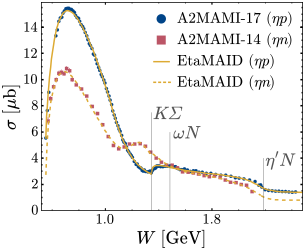
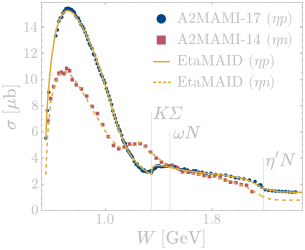
To fully disentangle broad, overlapping \(N^*\) resonances, modern studies therefore rely on coupled-channel analyses, which combine data from the different production mechanisms and from multiple final states into a single, consistent parametrisation of the energy-dependent dynamics. We discuss the techniques that these programmes employ in Section 2.4.3. The most well-known research programs are (in chronological order) the Scattering Analysis Interactive Dial-in (SAID) of George Washing University [79; 80], the Kent State University model [81], the Mainz Unitary Isobar Model (MAID) [82], the Bonn–Gatchina model [83], the Jülich–Bonn and Jülich–Bonn–Washington model [84; 85], and the Laurent–Pietarinen formalism [86]. An example by predictions of the MAID model for \(\eta\) and \(\eta'\) photo-production (EtaMAID) is shown in Figure 1.10.
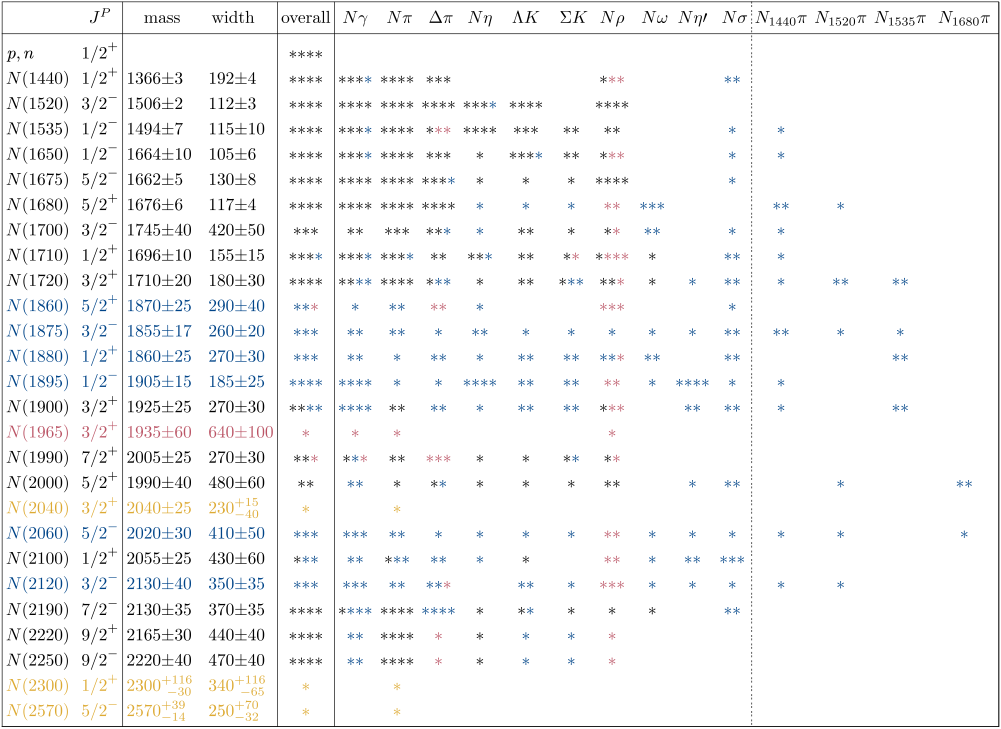
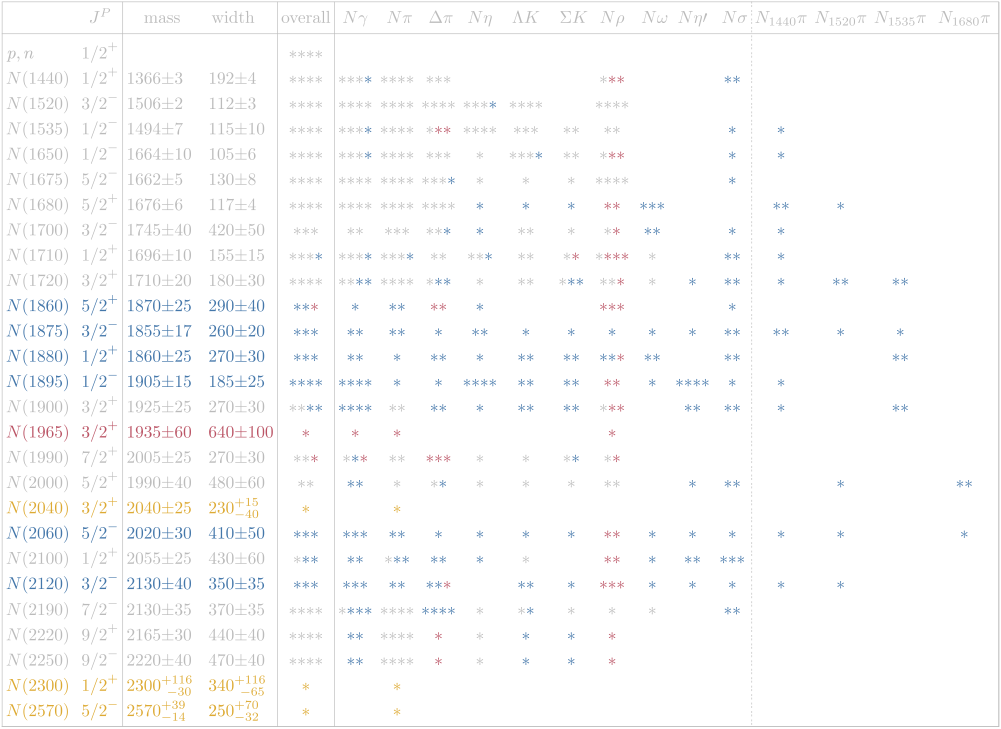
The success of these models lies in their ability to describe the growing body of experimental data. By fitting a wide range of reactions simultaneously, they allow resonance signals to be disentangled from background channels and from one another. The outcome is reflected in Table 1.3, which shows the \(N^*\) excitation spectrum currently determined from partial-wave analyses of experimental data. The table uses star ratings that indicate the degree of confidence assigned by the Review of Particle Physics [60]. As can be seen from the colours that highlight newer findings since 2004, the understanding of \(N^*\) excitations in the higher mass range has improved significantly. However, as discussed, not all states can be explained well by theory, and many states that are predicted, have not yet been observed.
\(N^*\) resonances in charmonium decays
Scattering experiments have long been the main source of information about nucleon excitations, but they are not the only way to study these states. Some of the higher-mass excitations listed in Table 1.3 have also been observed in decays of the \(J/\psi\) meson and higher charmonium states at the BESIII experiment. Charmonium denotes bound states of a charm quark and an anticharm quark (\(c\bar{c}\)) and includes states like \(J/\psi\). In these decays, the charmonium state produces an antinucleon and a nucleon, one of which can be an excited state. The main disadvantage is that the recoiling antinucleon limits the available phase space, and the multi-body final state can cause interference between different subsystems of completely different hadronic states. However, these decays have clear advantages: the \(J/\psi\) meson provides a precisely known production energy and well-defined initial quantum numbers, which reduces the number of partial waves and polarisation observables. Moreover, \(\varDelta\) resonances are heavily suppressed: because the \(J/\psi\) meson carries no isospin, the \(\bar{N} N^*\) pair must couple to \(I=0\), which excludes \(\varDelta^*\) states (\(I=\tfrac{3}{2}\)). \(J/\psi\) decays therefore provide a clean isospin filter that isolates \(N^*\) resonances without contamination from \(\varDelta\)’s.
So far, the BESIII collaboration has performed only a few dedicated studies of nucleon excitations. The main challenge has been to account for interference effects between different subsystems in multi-body decays involving baryons. Recently, however, correct solutions for this “spin alignment” problem (Section 3.3.2) have been developed and applied to studies at BESIII and LHCb. In this study, we take first steps towards applying these solutions to the decay \(J/\psi \to \bar{p}\left(N^*\to\varSigma^+K^0_S\right)\). In addition, we have prepared the computational techniques to couple this channel to \(J/\psi \to \bar{p}\left(N^*\to p \eta\right)\) and other future selections, so that broad resonances can be studied properly in this higher-mass region where simple Breit–Wigner parametrisations are insufficient. Eventually, this paves the way to combining these results with the extensive knowledge from scattering experiments, moving closer to a unified description of the nucleon excitation spectrum.