Generating decays#
This page shows the basic workflow: create a Generator, generate decay trees, and turn them into four-momentum arrays.
Creating a generator#
The default Generator uses the decay table (DECAY_FILE) and particle table (PARTICLE_TABLE) that ship with the package. A seed makes the generated events reproducible. Creating a Generator reads the decay and particle tables and initializes Pythia8, which prints a lot of log output. That output is hidden on this page.
EvtGen keeps its tables and random engine in global state. A process can therefore hold only one Generator, and creating a second one raises an error:
try:
    Generator()
except RuntimeError as error:
    print(error)
EvtGen has global state and can only be initialized once per process. Reuse the existing EvtGen instance.
EvtMTRandomEngine:Mersenne-Twister random number generator with seed = 1476487407
EvtGen:Defining EvtPythiaEngine: data tables defined in /home/runner/work/pyevtgen-test/pyevtgen-test/.venv/lib/python3.14/site-packages/pyevtgen/data/pythia8/xmldoc
EvtGen:Pythia 8 codes need to be used in decay files
EvtGen:Using EvtGen random engine for Pythia 8 as well
EvtGen:Creating generic Pythia generator

 *------------------------------------------------------------------------------------*
 |                                                                                    |
 |  *------------------------------------------------------------------------------*  |
 |  |                                                                              |  |
 |  |                                                                              |  |
 |  |   PPP   Y   Y  TTTTT  H   H  III    A      Welcome to the Lund Monte Carlo!  |  |
 |  |   P  P   Y Y     T    H   H   I    A A     This is PYTHIA version 8.318      |  |
 |  |   PPP     Y      T    HHHHH   I   AAAAA    Last date of change: 16 Sep 2026  |  |
 |  |   P       Y      T    H   H   I   A   A                                      |  |
 |  |   P       Y      T    H   H  III  A   A    Now is 09 Nov 2026 at 10:48:26    |  |
 |  |                                                                              |  |
 |  |   Program documentation and an archive of historic versions is found on:     |  |
 |  |                                                                              |  |
 |  |                               https://pythia.org/                            |  |
 |  |                                                                              |  |
 |  |   PYTHIA is authored by a collaboration consisting of:                       |  |
 |  |                                                                              |  |
 |  |   Javira Altmann, Christian Bierlich, Naomi Cooke, Nishita Desai,            |  |
 |  |   Ilkka Helenius, Philip Ilten, Joni Laulainen, Leif Lonnblad,               |  |
 |  |   Stephen Mrenna, Christian Preuss, Torbjorn Sjostrand, and Peter Skands.    |  |
 |  |                                                                              |  |
 |  |   The complete list of authors, including contact information and            |  |
 |  |   affiliations, can be found on https://pythia.org/.                         |  |
 |  |   Problems or bugs should be reported on email at authors@pythia.org.        |  |
 |  |                                                                              |  |
 |  |   The main program reference is C. Bierlich et al,                           |  |
 |  |   'A comprehensive guide to the physics and usage of Pythia 8.3',            |  |
 |  |   SciPost Phys. Codebases 8-r8.3 (2022) [arXiv:2203.11601 [hep-ph]]          |  |
 |  |                                                                              |  |
 |  |   PYTHIA is released under the GNU General Public Licence version 2          |  |
 |  |   or later. Please respect the MCnet Guidelines for Generator Authors        |  |
 |  |   and Users.                                                                 |  |
 |  |                                                                              |  |
 |  |   Disclaimer: this program comes without any guarantees.                     |  |
 |  |   Beware of errors and use common sense when interpreting results.           |  |
 |  |                                                                              |  |
 |  |   Copyright (C) 2026 Torbjorn Sjostrand                                      |  |
 |  |                                                                              |  |
 |  |                                                                              |  |
 |  *------------------------------------------------------------------------------*  |
 |                                                                                    |
 *------------------------------------------------------------------------------------*

EvtGen:Creating alias Pythia generator
The package records which versions of EvtGen, HepMC3 and Pythia8 it was built with, and where its data files are:
import pyevtgen

print("EvtGen ", pyevtgen.EVTGEN_VERSION)
print("HepMC3 ", pyevtgen.HEPMC3_VERSION)
print("Pythia8", pyevtgen.PYTHIA8_VERSION)
print(pyevtgen.DECAY_FILE.name, pyevtgen.PARTICLE_TABLE.name)
EvtGen  R03-01-00
HepMC3  3.3.1
Pythia8 8318
DECAY.DEC evt.pdl
Decay trees#
Generator.decay() decays a particle, given by its EvtGen name or PDG ID, and returns the root Particle of the decay tree. Each Particle holds its name, PDG ID, four-momentum \((E, p_x, p_y, p_z)\) in GeV, and its daughters.
event = generator.decay("D*+")
print_tree(event)
D*+        E = 2.010 GeV
  D+         E = 1.870 GeV
    K_S0       E = 0.755 GeV
      pi+        E = 0.250 GeV
      pi-        E = 0.505 GeV
    pi+        E = 0.555 GeV
    pi+        E = 0.203 GeV
    pi-        E = 0.357 GeV
  pi0        E = 0.140 GeV
    gamma      E = 0.067 GeV
    gamma      E = 0.073 GeV
The stable particles at the leaves of the tree are returned by Particle.final_state(). Their four-momenta add up to that of the parent:
final_state = event.final_state()
[particle.name for particle in final_state]
['pi+', 'pi-', 'pi+', 'pi+', 'pi-', 'gamma', 'gamma']
np.sum([particle.p4 for particle in final_state], axis=0)
array([2.01026000e+00, 9.02056208e-17, 4.51028104e-17, 1.80411242e-16])
Event samples#
Generator.generate() produces many decays at once. When all events have the same final state, final_state_momenta() stacks them into a NumPy array of shape (n_events, n_final_state, 4). Here, the \(D^0\) decays according to the full decay table, so we first select one decay channel:
events = generator.generate("D0", n=20_000)
channel = ["K-", "pi+"]
selected = [e for e in events if [p.name for p in e.final_state()] == channel]
len(selected)
811
from pyevtgen import final_state_momenta

momenta = final_state_momenta(selected)
momenta.shape
(811, 2, 4)
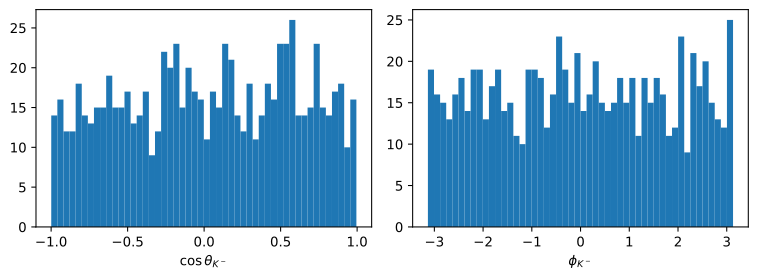
In this two-body decay at rest, both daughters have a fixed momentum, while their directions are distributed uniformly over all directions:
np.linalg.norm(momenta[:, :, 1:], axis=2).std(axis=0)
array([1.87667091e-15, 1.87667091e-15])
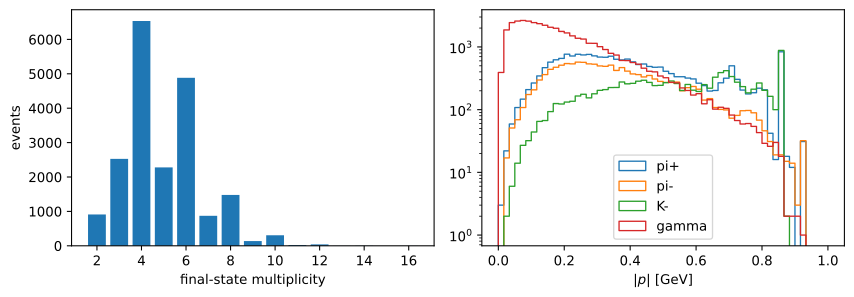
Without selecting a channel, the sample contains all \(D^0\) decays from the decay table. The final-state multiplicity and the momentum spectra of the most common particles illustrate this:
Moving parents#
By default, the parent decays at rest. Pass its four-momentum to generate decays in flight, for instance a \(D^0\) with an energy of 10 GeV along the \(z\) axis:
mass = generator.properties("D0").mass
energy = 10.0
p4 = [energy, 0.0, 0.0, np.sqrt(energy**2 - mass**2)]
event = generator.decay("D0", p4=p4)
np.sum([particle.p4 for particle in event.final_state()], axis=0)
array([ 1.00000000e+01, 0.00000000e+00, -6.93889390e-18, 9.82458188e+00])
Reproducibility#
The seed property reseeds the random engine, so the same seed gives the same events:
generator.seed = 7
first = generator.decay("D0").final_state()[0].p4
generator.seed = 7
second = generator.decay("D0").final_state()[0].p4
first == second
True