Final-state radiation#
Charged particles in the final state can radiate photons. EvtGen simulates this final-state radiation (FSR) for decay channels that carry the FSR (or legacy PHOTOS) flag in the decay file. Generator uses the QED shower of Vincia, which is part of Pythia8, when it is created with fsr=True. PHOTOS++ is not included.
The default decay table flags \(J/\psi \to \mu^+\mu^-\) for FSR:
from pyevtgen import DECAY_FILE

lines = DECAY_FILE.read_text().splitlines()
start = lines.index("Decay J/psi")
print("\n".join(lines[start : start + 3]))
Decay J/psi
0.059400000 e+      e-                                      FSR   VLL; #[Reconstructed PDG2011]
0.059300000 mu+     mu-                                     FSR   VLL; #[Reconstructed PDG2011]
Because a process can hold only one Generator, comparing FSR on and off requires two processes. The function below generates decays in a fresh Python process, with a user decay file that forces \(J/\psi \to \mu^+\mu^-\) including the FSR flag. For each decay, it returns the dimuon invariant mass, the number of photons, and their total energy.
import subprocess  # ruff: ignore[suspicious-subprocess-import]
import sys
from pathlib import Path
from tempfile import mkdtemp
from textwrap import dedent

import numpy as np

DIMUON_FILE = Path(mkdtemp()) / "dimuon.dec"
DIMUON_FILE.write_text("""
Decay J/psi
1.0 mu+ mu- FSR VLL;
Enddecay
End
""")


def generate_dimuons(*, fsr: bool, n: int = 5000) -> np.ndarray:
    """Return dimuon mass, photon count, and summed photon energy per event."""
    script = dedent(f"""
        import numpy as np
        from pyevtgen import Generator
        generator = Generator(fsr={fsr}, seed=0, user_decay_file={str(DIMUON_FILE)!r})
        events = generator.generate("J/psi", n={n})
        for event in events:
            names = [d.name for d in event.daughters]
            if "mu+" not in names or "mu-" not in names:
                continue
            muons = sum(np.array(d.p4) for d in event.daughters if d.name.startswith("mu"))
            mass = np.sqrt(muons[0] ** 2 - np.sum(muons[1:] ** 2))
            photons = [d.p4[0] for d in event.daughters if d.name == "gamma"]
            print("ROW", mass, len(photons), sum(photons))
    """)
    result = subprocess.run(  # ruff: ignore[subprocess-without-shell-equals-true]
        [sys.executable, "-c", script], capture_output=True, check=True, text=True
    )
    lines = result.stdout.splitlines()
    rows = [line.split()[1:] for line in lines if line.startswith("ROW")]
    return np.array(rows, dtype=float)
fsr=False: 20000 decays, 0.0% with photons
fsr=True: 20000 decays, 32.1% with photons
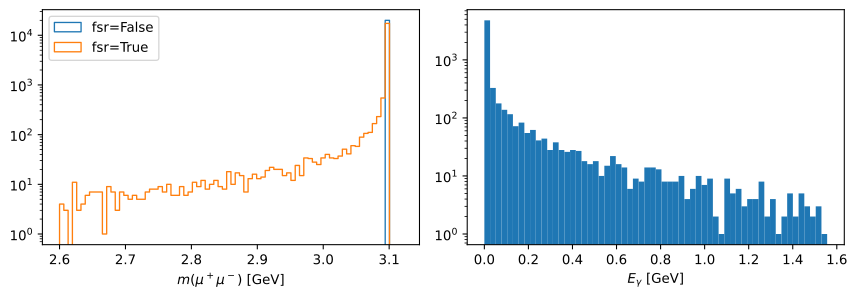
The radiated energy is missing from the muon pair, so the dimuon invariant mass develops a radiative tail below the \(J/\psi\) mass. The photon energy spectrum is steeply falling, as expected for soft radiation: